
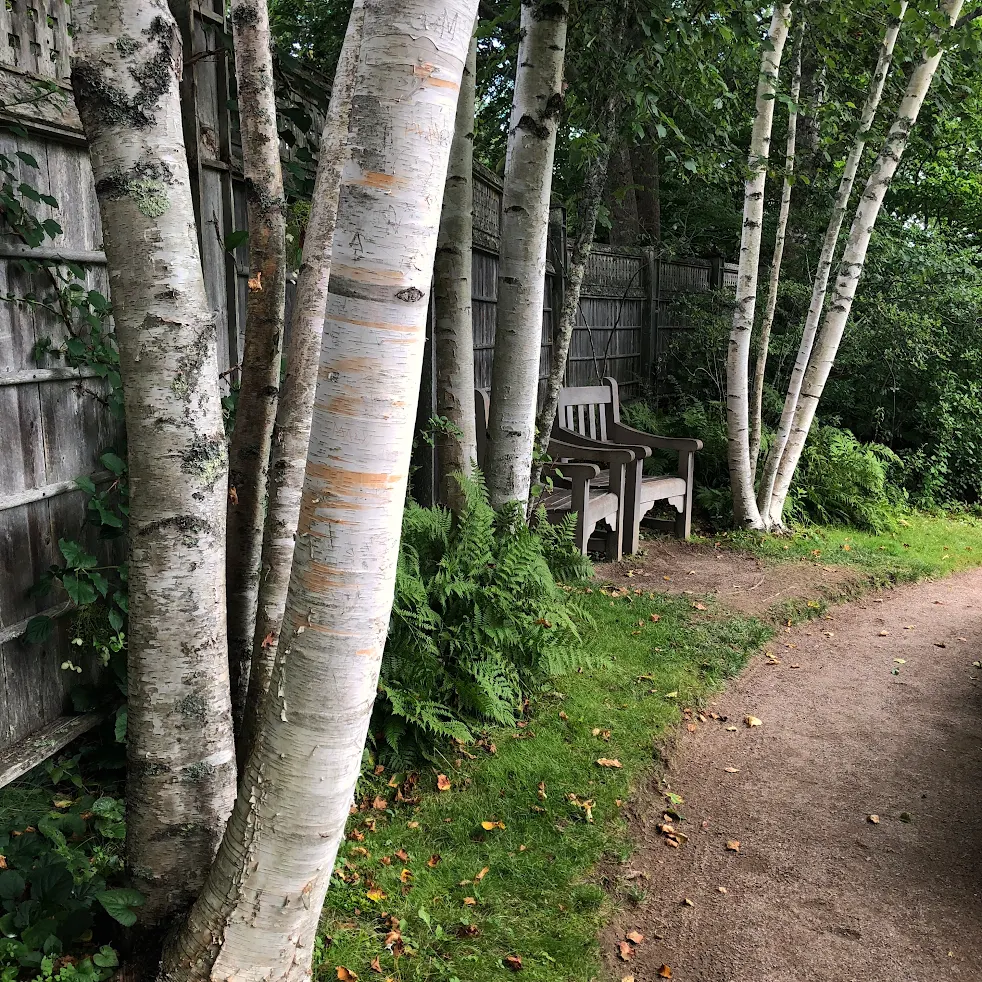
Most gardeners think of winter as downtime – a long pause between the last frost and the first crocus. But if your yard feels bleak and colorless from December through March, that’s not a feature of winter. It’s a design problem, and one that’s entirely solvable.
At A Yard and a Half, we’ve spent years helping New England homeowners create landscapes that earn their keep in every season – including the gray, blustery months when curb appeal matters most and a beautiful view from the window feels like a small luxury.
Whether you’re looking out at your garden over a cup of coffee or catching a glimpse on the way to the car, the winter garden deserves the same thoughtful attention you’d give your summer perennial beds or your fall foliage scheme. Here’s how to think about it – and which plants we reach for again and again.
What Is a “Year Round Garden,” Really?
When landscape designers talk about year round gardens, they’re not just gesturing at evergreens and calling it a day. A true four-season garden is one that offers something worth noticing during every month of the year – including January and February, when most of us would rather stay inside.
In winter, the design toolkit shifts. You’re no longer relying on flowers or lush green foliage.
Instead, the most effective winter gardens lean on:
- Bark and branch texture – the exfoliating peel of a birch, the layered architecture of a mature shrub
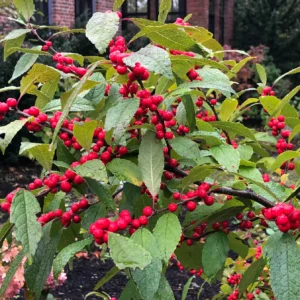
- Persistent berries – fruit that clings to stems long after leaves have dropped
- Stem color – electric reds and yellows that practically glow against snow or a gray sky
- Evergreen structure – needled plants that maintain form, color, and privacy through the coldest months
- Early bloom times – plants that wake up ahead of everything else, offering the first promise of spring
One thing experienced gardeners know: bright colors often look more vibrant against gray winter skies than they do in full summer sun. The contrast does the work for you. A cluster of red-stemmed dogwoods or a winterberry holly covered in orange-red fruit can be as visually striking in January as any midsummer border.
Our Favorite Plants for the New England Winter Garden
The following plants are tried-and-true performers in the New England landscape. They’re cold-hardy, largely native or well-adapted to the region, and chosen specifically because they look their best – or at least their most interesting – when everything else has gone dormant.
Paper Birch and River Birch (Betula papyrifera and Betula nigra)
Few trees are more iconic in the New England landscape than the birch, and for good reason. Both Paper Birch and River Birch reveal their best quality in winter: exfoliating bark that peels away in papery layers to reveal warm cream, cinnamon, and taupe tones beneath.
Typically multi-stemmed and vase-shaped, birches offer a kind of vertical drama without overwhelming a space. Their branching structure provides some privacy screening at upper levels of a house without crowding pathways or blocking lower-story windows – a practical consideration in residential landscapes. They’re also beautiful in groups of three, creating a naturalistic grove effect.
One important siting note: River Birch (Betula nigra) is a thirsty tree, evolved to grow along riverbanks and flood plains. Planted too close to your home, its roots may migrate toward underground pipes, especially during dry summers. Give it a spot with adequate room and, ideally, a naturally moist area of your yard.
Best for: Specimen planting, naturalistic groves, woodland edges, privacy screening at height
Winterberry Holly (Ilex verticillata)
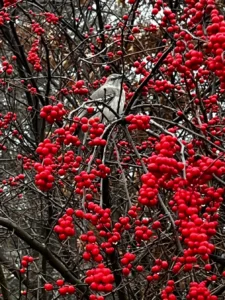
If we had to pick one native plant for maximum winter impact, this would be a serious contender. Winterberry Holly is smothered in jewel-toned red or orange berries that persist on its bare branches well into early spring. The berries ripen slowly, which means they remain on the plant long after deciduous trees have shed their leaves – leaving the berries to do their visual work without competition.
Unlike many ornamental shrubs, Winterberry Holly has a naturally graceful, loose form that doesn’t require aggressive pruning to look good. With a light hand, you can encourage a beautifully naturalistic shape that reaches about ten feet at maturity. There are also numerous smaller cultivars – some topping out at just three to four feet – making this an excellent candidate for entry gardens, foundation plantings, and more urban or suburban spaces with limited square footage.
One note for new gardeners: Winterberry is dioecious, meaning you need both a male and female plant for the female to produce berries. Your local nursery can help you select the right pollinator.
Best for: Native plantings, rain gardens, wildlife gardens, foundation beds, entry gardens
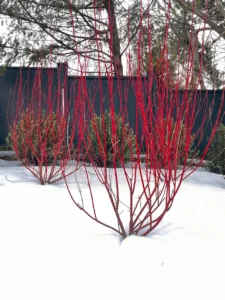
Redtwig and Yellowtwig Dogwood (Cornus sericea and cultivars)
Don’t confuse these with the flowering dogwood tree (Cornus florida) that blooms in spring – these are shrubs, and they’re at their most spectacular in winter, after the leaves have fallen and the stems are fully exposed. The branching of Redtwig Dogwood in particular is a striking sight: bright red stems that practically fluoresce against snow, especially when planted in large, sweeping masses.
Yellowtwig Dogwood (Cornus sericea ‘Flaviramea’) offers the same structural impact in a warm, pale gold – a slightly softer effect that pairs beautifully with the red-stemmed variety for contrast.
Both are fast growers, which means they fill space quickly – useful for new landscapes that need to establish screening in a hurry. The trade-off is that older stems lose their color vibrancy over time, turning a dull gray-brown. The solution is simple: cut stems back hard every two or three years to encourage fresh growth, which is always the most colorful.
Compact cultivars are available that top out at four to eight feet, rather than the standard ten to twelve – a much better fit for many residential gardens.
Best for: Mass plantings, hedgerows, screening, rain gardens, mixed shrub borders
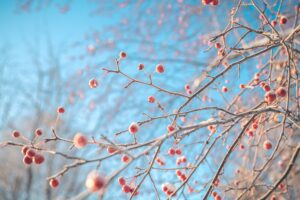
Crabapple (Malus spp.)
The crabapple is one of New England’s most beloved and versatile ornamental trees – and it pulls double duty across all four seasons. In late spring, it erupts in clouds of white, pink, or red blossoms. Come fall and winter, those blossoms give way to small fruit that persists on the branches and becomes a critical food source for birds, squirrels, raccoons, and other winter foragers.
Old crabapples have a wonderfully gnarled, sculptural form – an instantly recognizable silhouette found along New England roadsides, in farmyards, and on the edges of sunny fields. That form becomes most apparent in winter, when you can see the full architecture of the branching without foliage to obscure it.
Modern cultivars have also addressed one of the historic downsides of crabapples: disease susceptibility. Many newer selections are bred for resistance to apple scab and other common fungal issues, making them lower-maintenance additions to the landscape.
Best for: Wildlife gardens, specimen trees, mixed borders, pollinator gardens
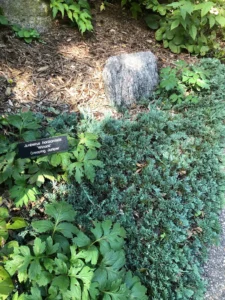
Creeping Juniper (Juniperus horizontalis)
If you’ve ever driven along a New England highway or walked through a parking lot landscape in winter and noticed a low, spreading evergreen with a silvery-mauve tone, you’ve almost certainly encountered a Creeping Juniper. This reliably tough, low-maintenance plant has been cultivated into a wide range of forms, but all share the same basic character: a spreading, ground-hugging habit that provides year-round color, texture, and erosion control.
One of the most celebrated cultivars – “Bar Harbor” – comes from Maine’s Mount Desert Island, which perhaps explains its rock-solid cold hardiness. It grows just one foot tall but spreads up to six feet wide, making it an excellent choice for slopes, rock gardens, and spaces where a larger shrub would be out of scale. Its foliage shifts from a blue-gray during the growing season to a distinctive mauve-purple in winter, providing a subtle but lovely color change that marks the seasons.
Its cousin, Eastern Red Cedar (Juniperus virginiana), grows much larger – anywhere from eight to forty feet – and provides outstanding wildlife habitat, nesting sites, and screening value at a larger scale.
Best for: Slopes, rock gardens, low-maintenance groundcover, erosion control, winter interest in small spaces
Putting It All Together: Designing for Winter
The best winter gardens aren’t accidents. They’re designed with intention – with an eye on which plants will hold their interest in the hardest months, and how those plants work together as a composition.
When we’re helping clients plan for year-round interest, we think about layering: a canopy tree like a birch for height and bark texture, a mid-layer shrub like Winterberry Holly or Redtwig Dogwood for color and berries, and a ground layer of Creeping Juniper or other low evergreens for structure and weed suppression. Within each layer, we think about bloom time, fruit color, stem color, and bark – staggering these qualities so that something is always doing something interesting.
Winter also tends to reveal the bones of a garden – the shapes, the sightlines, the structure – more clearly than any other season. It’s worth paying attention to what yours reveals, because what you see in February is the framework everything else grows within. If that framework is beautiful, every other season benefits.
A Yard and a Half is a landscape design and installation company serving the Greater Boston area. We specialize in sustainable, year-round gardens that are beautiful in every season. Contact us to learn more about winter garden design and landscape consultations.